Research & projects. Simulations, software and research in progress.
Each project states its current status.
Interactive experiments built on the research data.
Polymers & molecular materials
Building materials, preparing them for simulation, and studying what moves through them.
·
- H₂/CH₄ transport in polyethylene. Molecular dynamics of gas diffusion in amorphous polyethylene, comparing temperature and simulation ensembles. Paper · Code. Published in ACS Applied Polymer Materials, 2026.
- POLYMER-FLOW. Every molecular-dynamics study of a polymer starts by building and equilibrating the material again, and fighting until it reaches the right density. POLYMER-FLOW turns that into one declarative specification (polymer, chain length, number of chains, force field, temperature, pressure and acceptance criteria). It grows and packs the chains, compresses and anneals them, checks density, stationarity and bonds, and returns a LAMMPS data file ready to simulate. Prototype — polyethylene only so far; more polymers and validation against experimental densities pending.
- Asphaltene-reinforced nanocomposites. Mechanical behaviour of polymer composites with asphaltenes, carbon black and hybrid fillers. Simulation study and manuscript under revision.
- Gas barriers in nanocomposites. A companion study of how those fillers affect gas diffusion through the polymer matrix. Analysis and validation in progress.
- PE/PP compatibilization. Exploring asphaltenes as interfacial additives for polyethylene/polypropylene blends, with a focus on adhesion and mechanical response. Research project.
Drilling, production & well operations
What happens downhole, what the surface can tell us about it, and tools for operating wells.
· ·
A column of mud in a well deep pushes on the bottom with 368 bar. If the formation holds of pore pressure, the well is overbalanced by 44 bar.
Change a number: type, use the arrow keys, or drag it sideways. Static mud column only, P = ρ·g·TVD; no circulation, temperature or compressibility. The fracture line assumes 1.75 sg and is there for scale, not from a real well.
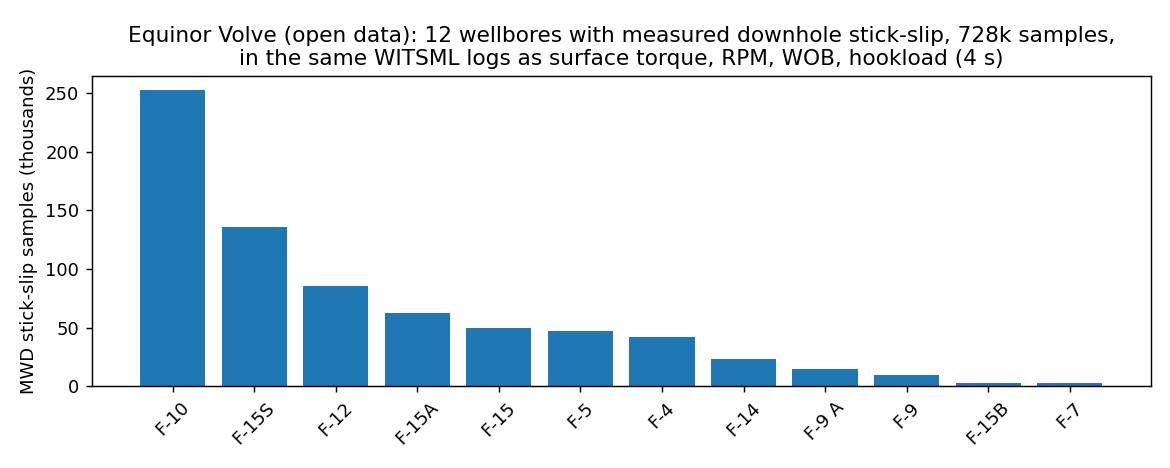
- What can surface drilling data detect downhole? With Dr. Roman Shor: an open benchmark of stick-slip detection from surface torque and rotary speed on public field data from the Volve field (Equinor) and Utah FORGE, using downhole measurements as ground truth. It compares a detector trained only on simulations of the Aarsnes–Shor torsional model, supervised machine learning and a simple torque-variability index. Downhole spectra explain the ceiling they share: much of what downhole tools record as stick-slip at FORGE is high-frequency torsional oscillation, which surface data cannot see. Abstract submitted to the 52nd Stanford Geothermal Workshop (February 2027); journal paper in preparation.
- Why high-frequency torsional oscillation stays in the BHA. A wave model of the drill string in which the tool joints form a torsional stop band, trapping the dominant modes in the bottom-hole assembly, compared with per-second downhole spectra from Utah FORGE. Analysis in progress; more field data requested.
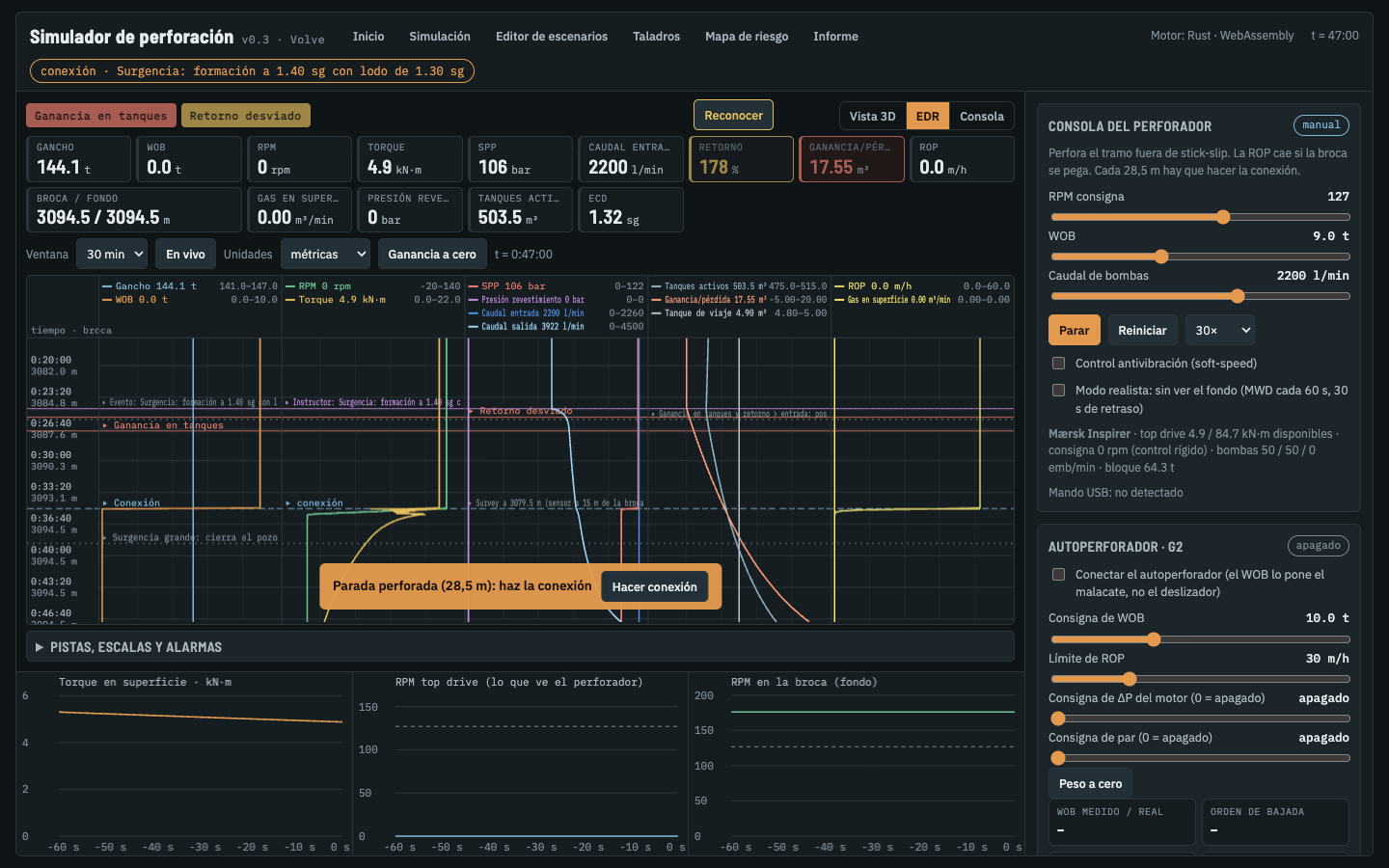
- Drilling simulator. A real-time Rust engine and operator interface based on the Mærsk Inspirer and Volve wells, covering string dynamics, hydraulics and well-control scenarios. Prototype.
- Hydraulic-fracture control with ML. An exploratory study of whether injection controls and available observations can support fracture-geometry control. Feasibility study — data and observability limitations identified.
- Petroleum Production Systems, rewritten. A modern rewrite of the program that accompanies Economides, Hill, Ehlig-Economides and Zhu's textbook: 63 production-engineering calculations (PVT, inflow performance, wellbore flow, chokes, nodal analysis, well testing, gas lift, fracturing, acidizing, material balance), checked against the original 1997 Fortran program and the book's worked examples. Working software.
- Pore Pressure Lab. Interactive lessons, a conceptual compaction simulator and log-interpretation exercises covering pore pressure, effective stress and formation-pressure estimation. Educational software.
- Autowell. A concept for a multiproduct well or well hub whose operating decisions respond to market conditions, including an in-situ hydrogen pathway. Concept study.
Figures: simulator display and field-data inventory
Enhanced oil recovery, across scales
From molecular interactions to reservoir behaviour.
·
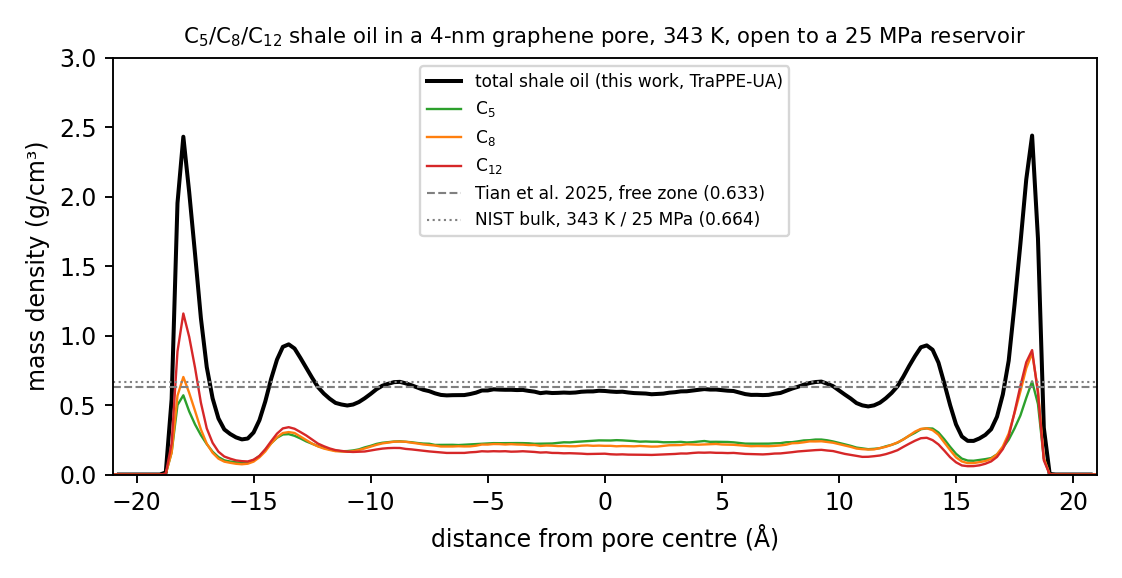
- Gas EOR from nanopore to reservoir. Connecting LAMMPS molecular simulations with OPM Flow models to investigate confinement, adsorption and water in CO₂ huff-n-puff. In progress.
- MOF nanofluids for EOR. Modelling UiO-66 nanoparticles, brine, oil and asphaltene-aged mineral surfaces. Rebuilding the workflow with component validation after auditing the original simulations. Model redevelopment.
Figure: nanopore density profile
CO₂ storage, recovery & project economics
A related set of studies, from reservoir mechanisms to field selection.
- CO₂ storage in depleted heavy-oil reservoirs. Reservoir simulations of trapping mechanisms and the storage–recovery trade-off. First pass complete; being rerun with a real-gas CO₂ description before any results are reported.
- CO₂-EOR across crude types. A proposed extension comparing oil recovery and CO₂ storage across the API-gravity spectrum. Research plan.
- Which real fields are viable for CO₂-EOR? A proposed screening workflow combining public field data, simulation and economics to examine where injection could make sense. Research plan.
- CCS and low-carbon energy projects. Technical and business studies of storage opportunities, project integration and candidate assets. Exploratory studies.
Geothermal & thermal reservoir simulation
Hot reservoirs where water boils near the well, and how to study them in minutes instead of days.
- Geothermal simulation with open-DARTS. A pressure–enthalpy model that keeps running where water flashes to steam around the producer. It migrates an ECLIPSE 300 THERMAL model of a 310 °C reservoir to open-DARTS, matching the producer's mass rate within 0.3–0.8 %, and reproduces classic thermal benchmarks: Stanford's 1980 radial boiling problem and the SPE 4 cyclic-steam and steamflood problems. Research in progress.
- ML surrogates for geothermal studies. Gaussian-process surrogates with active learning, so that a study needs a few dozen simulations rather than hundreds. On NREL's public Brady Hot Springs dataset (101 cases), a PCA + Gaussian-process surrogate reached lower cross-validation error than the published neural network. Training datasets being regenerated after a fluid-property correction; results shown are on public benchmarks.
- Thermal-study automation. An ECLIPSE deck reader and checker, a deck-to-DARTS translator, an automatic validator and a case factory: the steps that usually take hours of manual editing between simulator runs. Working tools, in development.
Reactive molecular simulation
- H₂S interacting with iron. Reactive molecular simulations using ReaxFF, with temperature-dependent runs and hydrogen-diffusion analysis. Simulation files and results; scientific review pending.
Publications
- Delgado Uriarte, D., & Shor, R. J. Stick-slip and HFTO at Utah FORGE: what surface drilling data can and cannot detect. Abstract submitted to the 52nd Stanford Geothermal Workshop, Stanford, CA, February 2027. Submitted.
- Delgado-Uriarte, D., & López, A. (2026). Ensemble-dependent diffusivity selectivity in amorphous polyethylene: a statistically validated molecular dynamics study of H₂/CH₄ transport. ACS Applied Polymer Materials. doi:10.1021/acsapm.6c00287 · code Published.
- Delgado Uriarte, D. (2023). Device for detection of hydrogen leaks in pipe systems and installations. Spanish utility model ES U202330768, published 7 September 2023. Published.
Manuscripts in preparation are listed with their projects above, not here.
Contact & collaboration
I welcome collaboration on related questions, particularly connecting molecular simulation, reservoir modelling and physics–ML tools.
Tell me which project caught your attention, what you are working on, and how we might work together. Questions about the code and research are welcome too.
danieldelgadouriarte [at] gmail [dot] com
Send a message
Your message goes to Daniel by e-mail, with your address as the reply-to. It is not stored on this website. A short automatic check in your browser keeps spam robots out.