In plain language
In a hot geothermal reservoir, pressure falls near a producing well and the water can boil (flash) into steam. Thermal simulators can stall exactly there.
This work uses the open-source simulator open-DARTS with a pressure–enthalpy formulation that keeps running through boiling, checks it against published benchmarks, and adds machine-learning surrogates so that a study needs a few dozen simulations rather than hundreds.
What is new
- Migration of an ECLIPSE 300 THERMAL model of a 310 °C reservoir to open-DARTS, matching the producer’s mass rate within 0.3–0.8 %.
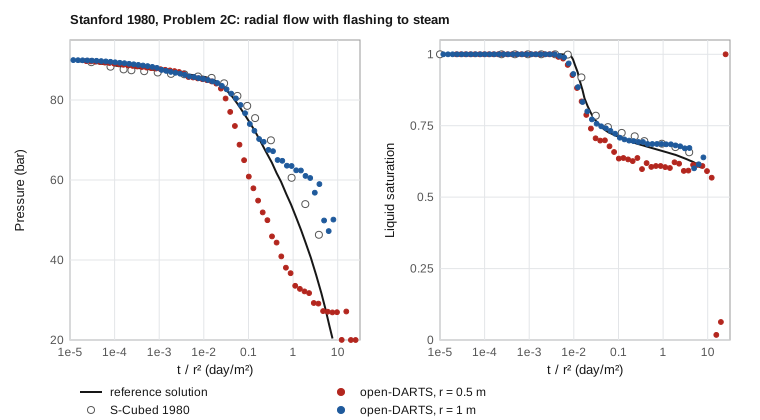
- Checks against classic thermal benchmarks: Stanford’s 1980 radial boiling problem (figure above) and the SPE 4 cyclic-steam and steamflood problems.
- Gaussian-process surrogates with active learning. On NREL’s public Brady Hot Springs dataset (101 cases), a PCA + Gaussian-process surrogate reached lower cross-validation error than the published neural network.
- Tools for the steps that usually take hours of manual editing between simulator runs: an ECLIPSE deck reader and checker, a deck-to-DARTS translator, an automatic validator and a case factory.
Data used
- NREL Brady Hot Springs simulation dataset (geothermal_osr, GDR submission 1346, BSD-3 licence): 101 cases, inputs are the flow allocation of the 10 wells.
- Stanford 1980 Problem 2C reference solution and S-Cubed results, from the Waiwera benchmark suite.
- The Fourth SPE Comparative Solution Project (Aziz, Ramesh & Woo, JPT 1987, SPE 13510).
Status
Research in progress. Training datasets are being regenerated after a fluid-property correction; the results shown are on public benchmarks. Related geothermal work: the drilling study at Utah FORGE, a geothermal research site, has an abstract submitted to the 52nd Stanford Geothermal Workshop (see the drilling summary).
Work on this together
If you run geothermal or thermal studies and want fewer simulations per study, a model moved to open-DARTS, or another benchmark checked, propose it.
Propose a collaboration CV (PDF)
The button opens the contact form on the home page with this project already selected. Your message goes to Daniel by e-mail.
Related
- All geothermal and thermal reservoir simulation projects
- Stick-slip and HFTO at Utah FORGE (abstract submitted to Stanford)
- CO₂ storage and recovery projects
Other research summaries: What surface drilling data can detect downhole · H₂/CH₄ transport in polyethylene