In plain language
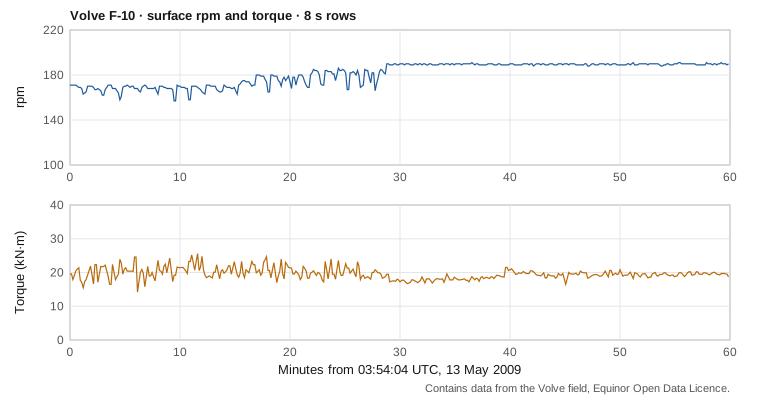
In stick-slip, the bit at the bottom of a well repeatedly stops and then spins faster than the drill string is turned at the surface. Downhole tools can record it directly, but most wells only have surface data: the torque and rotary speed measured at the rig.
This work asks how much of what happens at the bit can be read from those surface signals, and where the limit is, by testing detectors on real wells where the downhole answer is known.
What is new
- An open benchmark on public field data from two very different settings, the Volve field (Equinor) and Utah FORGE, with downhole measurements as ground truth.
- It compares three kinds of detector on the same data: one trained only on simulations of the Aarsnes–Shor torsional model, supervised machine learning, and a simple torque-variability index.
- Downhole spectra explain the ceiling they share: much of what downhole tools record as stick-slip at FORGE is high-frequency torsional oscillation (HFTO), which surface data cannot see.
- A companion analysis: a wave model of the drill string in which the tool joints form a torsional stop band, trapping the dominant modes in the bottom-hole assembly, compared with per-second downhole spectra from Utah FORGE.
Data used
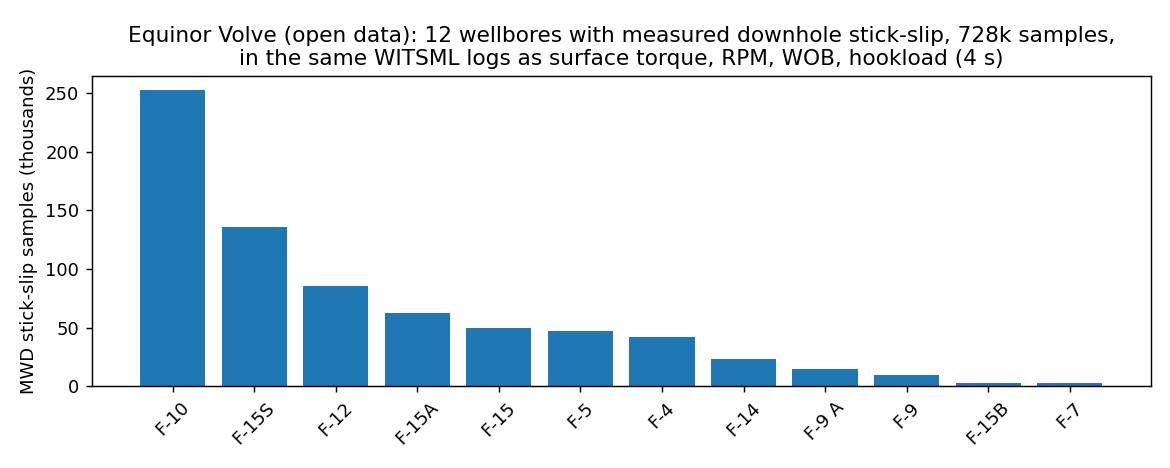
- Volve field drilling data (Equinor Open Data Licence): surface rpm, torque, weight on bit and rate of penetration, with downhole stick-slip measurements in twelve wellbores.
- Utah FORGE: surface drilling data (well 16A(78)-32) and per-second downhole spectra.
- Simulations of the Aarsnes–Shor torsional drill-string model, used to train the simulation-only detector.
Status
Research in progress. Abstract submitted to the 52nd Stanford Geothermal Workshop (February 2027): Delgado Uriarte, D., & Shor, R. J. Stick-slip and HFTO at Utah FORGE: what surface drilling data can and cannot detect. Journal paper in preparation. The stop-band analysis is in progress, and more field data has been requested.
Work on this together
If you have a stick-slip or torsional-vibration detector, a drill-string model, or field data with downhole measurements, testing it on the same benchmark is the most direct way to work together.
Propose a collaboration CV (PDF)
The button opens the contact form on the home page with this project already selected. Your message goes to Daniel by e-mail.
Related
- All drilling, production and well-operations projects
- Figure 1 and the bit-run replay of Volve F-10
- Geothermal simulation with open-DARTS and ML surrogates
Other research summaries: Geothermal simulation with open-DARTS and ML surrogates · H₂/CH₄ transport in polyethylene