In plain language
Molecular dynamics follows every molecule in a small box of material to see how gases move through it. For hydrogen and methane in amorphous polyethylene, the study compares temperatures and simulation ensembles and checks the results statistically.
The result in the title: the diffusivity selectivity between H₂ and CH₄ depends on the ensemble chosen for the simulation. The study began as the bachelor’s thesis at Universidad de Deusto and UPV/EHU.
What is new
- A statistically validated molecular dynamics study of H₂/CH₄ transport in amorphous polyethylene, comparing temperature and simulation ensembles.
- Published with its code: github.com/danieldelgadouriarte/pe-h2-ch4-md.
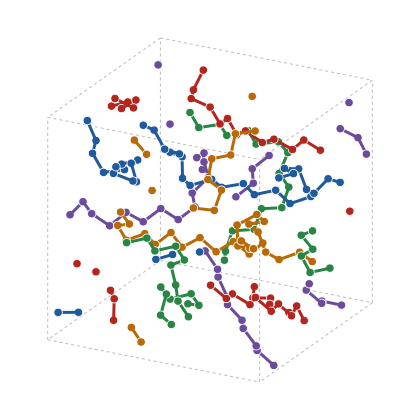
- POLYMER-FLOW: every molecular-dynamics study of a polymer starts by building and equilibrating the material again. POLYMER-FLOW turns that into one declarative specification (polymer, chain length, number of chains, force field, temperature, pressure and acceptance criteria). It grows and packs the chains, compresses and anneals them, checks density, stationarity and bonds, and returns a LAMMPS data file ready to simulate.
Data used
- Molecular dynamics of amorphous polyethylene with H₂ and CH₄; the code is public in the repository above.
- POLYMER-FLOW quick test shown in the figure: five polyethylene chains, 200 united-atom sites.
Status
Published. Delgado-Uriarte, D., & López, A. (2026), ACS Applied Polymer Materials. POLYMER-FLOW is a prototype, polyethylene only so far; more polymers and validation against experimental densities are pending. Related studies in progress: asphaltene-reinforced nanocomposites (manuscript under revision) and gas barriers in nanocomposites.
How to cite
Delgado-Uriarte, D., & López, A. (2026). Ensemble-dependent diffusivity selectivity in amorphous polyethylene: a statistically validated molecular dynamics study of H₂/CH₄ transport. ACS Applied Polymer Materials. https://doi.org/10.1021/acsapm.6c00287
Volume, issue and page numbers: see the DOI link, which always points to the publisher’s current record.
Work on this together
If you work on gas transport in polymers, polymer liners or membranes, or need equilibrated polymer models for LAMMPS, propose a joint study or try POLYMER-FLOW on your polymer.
Propose a collaboration CV (PDF)
The button opens the contact form on the home page with this project already selected. Your message goes to Daniel by e-mail.
Related
- All polymer and molecular-simulation projects
- Reactive molecular simulation of H₂S and iron (ReaxFF)
- Publications
Other research summaries: What surface drilling data can detect downhole · Geothermal simulation with open-DARTS and ML surrogates